


Product Overview
Engineered to meet rigorous international garment and industrial standards, our stretch fabric portfolio provides controlled elasticity, high dimensional stability, and durable physical strength. Every production lot undergoes multi-stage technical inspection - from grey fabric knitting tension control to final heat-setting - ensuring reliable batch-to-batch consistency for volume manufacturing.


Fabric Types
Our catalog is structured by technical construction to match specific end-use engineering requirements:
Four-Way Stretch Knits
Multi-directional elastic structures delivering balanced horizontal and vertical elongation. Ideal for form-fitting activewear, performance lining, and ergonomic garments.
Heavy-Duty Stretch Textiles
High-density constructions (120 g/m² to 480 g/m²) featuring double-spandex core configurations with an elastic recovery rate exceeding 95% (surpassing the standard 90% benchmark).
Mechanical Stretch Woven & Knit Hybrids
Synthetic filament structures engineered for elasticity without elastane degradation, offering superior resistance to industrial laundering, chlorine, and thermal stress.
Specialty Functional Surfaces
Includes stretch towel/fleece, stretch velvet produced in dust-free workshops, and technical shades with controlled light-blocking performance.
Technical Specifications
Standard production parameters and verification metrics utilized in our facility:
|
Specification Parameter |
Technical Range |
Testing Standard |
|
Weight (GSM) |
120 g/m² - 480 g/m² (Customizable) |
ASTM D3776 / ISO 3801 |
|
Usable Width |
145 cm - 185 cm |
ASTM D3774 / ISO 22198 |
|
Fiber Composition |
Polyester, Nylon, Spandex/Elastane blends, Cotton-synthetic blends, GRS-certified recycled PET |
AATCC 20 / ISO 1833 |
|
Elastic Recovery Rate |
Greater than or equal to 95% (After 30-minute tension release cycle) |
ASTM D3107 / ISO 20932 |
|
Color Fastness |
Grade 4 - 5 (Washing, perspiration, and crocking) |
AATCC 61-2A / ISO 105-C06 |
|
Color Tolerance |
Delta E less than 1.0 (Controlled via spectrophotometer matching) |
AATCC Evaluation Procedure 7 |
Applications
Engineered for sectors requiring dynamic mobility, structural durability, and comfort:
Activewear & Athleisure
Leggings, training shorts, and thermal base layers requiring high elasticity and moisture management.
Ergonomic Workwear
Industrial uniforms and utility trousers requiring high tear resistance and bending comfort.
Automotive & Interior Soft Goods
Seat cover facings, headliners, and trunk liners requiring thermal and dimensional stability.
Luggage, Packs & Outdoor Gear
Expandable pockets, compression straps, and harness padding utilizing high-tenacity stretch configurations.
Customization Options
We adjust yarn parameters, chemical formulas, and machine settings to match your Technical Data Sheets (TDS):

Yarn Engineering
Integration of high-tenacity filament yarns, anti-microbial silver-ion threads, or GRS-certified recycled polyester.

Dyeing & Chemical Finishing
Two-step dyeing processes (e.g., base tone over-dyeing), pad-batch dyeing, and specialized functional coatings (DWR water repellency, anti-static, flame retardancy).
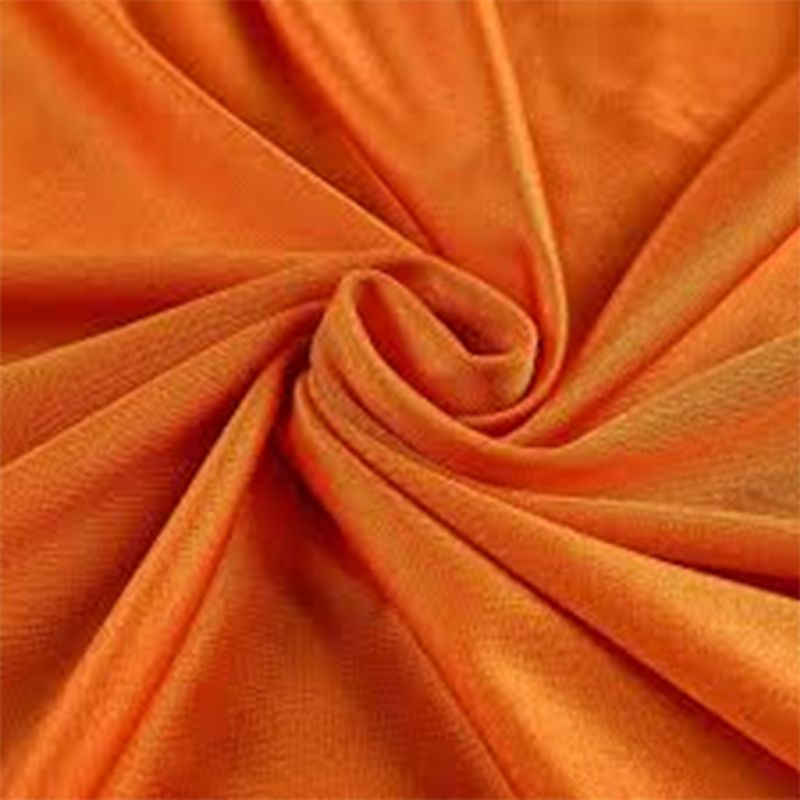
Roll & Packing Configuration
Continuous roll lengths up to 200 meters, wound onto 2-inch or 3-inch rigid paper cores, sealed in inner polyethylene film and outer woven bales for sea freight protection.
Quality Control & Testing
Our in-house quality assurance protocol verifies raw materials and finished lots prior to dispatch:
Dimensional Stability
Shrinkage testing performed after commercial washing and dry-heat exposure.
Physical Strength
Evaluation of bursting strength, Martindale abrasion resistance, and seam slippage.
Color Matching
Spectrophotometer verification under multiple lighting sources (D65, TL84, CWF) maintaining a strict Delta E limit. Master batch retain samples are archived for 2 years for full traceability.
Compliance
Chemical inputs comply with OEKO-TEX Standard 100 and EU REACH restricted substances guidelines.
Frequently Asked Questions

Request a Fabric Quote
To obtain a prompt technical quotation, please share your project requirements:
Intended application and end-use
Target weight (GSM) and usable width
Fiber composition or performance criteria
Estimated order volume (meters)
We're well-known as one of the leading stretch fabric manufacturers and suppliers in China. With a professional production team, we are able to meet the needs of the majority of our customers. Please rest assured to wholesale bulk customized stretch fabric from our factory.
Pink Stretch Velvet Fabric, Stretch Shade Fabric, Stretch Towelling Fabric